
Last reviewed: November 2026
340B State Laws in 2026: A State-by-State Comparison of Contract Pharmacy Protections
Compare 340B state laws in 2026: which states protect contract pharmacies, litigation status, reporting mandates, and a multi-state compliance checklist.
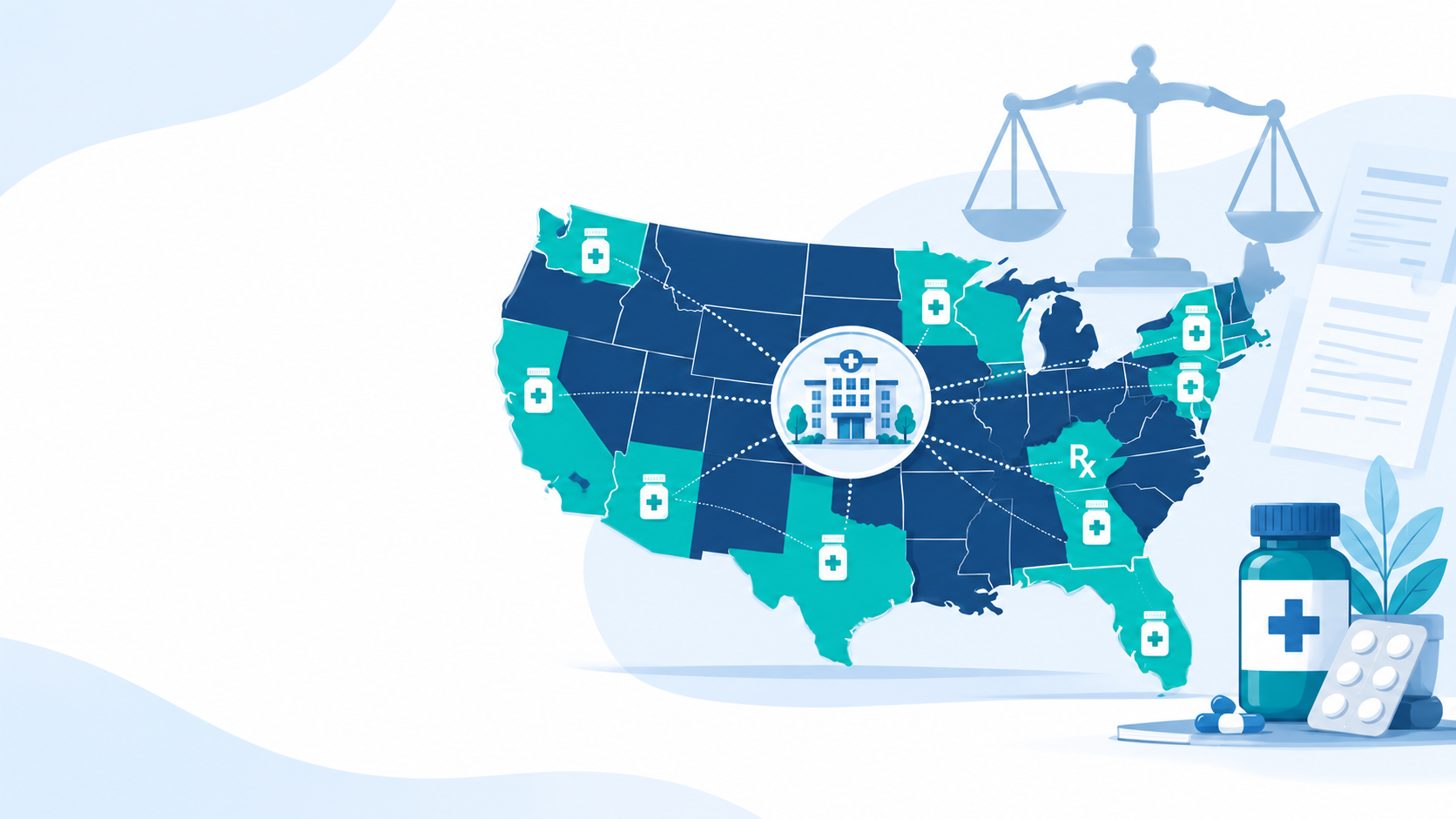
340B state laws now decide, as much as federal rules do, whether a covered entity can keep using its contract pharmacies without manufacturer interference. Twenty states have enacted contract pharmacy protection laws, several are tied up in court, and others add reporting or PBM rules on top. This guide compares state 340B contract pharmacy laws side by side, explains how manufacturer restrictions interact with each one, and gives you a working process for multi-state 340B compliance.
The federal 340B Program sets the discount, but it says little about how many pharmacies a covered entity may use. Since 2020, drug makers have filled that gap with their own conditions: one-pharmacy limits, claims-data demands and exclusions for certain sites. States responded. If you run a health system, an FQHC or a critical access hospital with pharmacies in more than one state, the question is no longer "Does my manufacturer have a policy?" It is "Which state law applies to this pharmacy, is that law in force today, and does it cover this specific restriction?"
We built this comparison from the same matrix our team uses during contract pharmacy management engagements. It reflects publicly reported status as of the review date above. Treat it as a starting point, then confirm each state against the current statute, court docket and manufacturer notice before you change operations.
In this guide: why state laws exist · the 20-state comparison table · litigation and pre-emption · reporting, AG enforcement and PBM rules · a 9-step multi-state compliance process · common mistakes · FAQs
Quick Answer: What Do 340B State Laws Do?
340B state laws are state statutes that stop drug manufacturers (and sometimes distributors, PBMs and payers) from restricting a covered entity's access to 340B-priced drugs dispensed through contract pharmacies. As of the 2026 review, NACHC counts 20 states with contract pharmacy protections. Their scope, effective dates and litigation status differ, so each state must be checked on its own.
Key takeaways
- 20 states have contract pharmacy protection laws; at least four have faced injunctions (North Dakota, Maryland, Oklahoma, West Virginia, per the AHA litigation tracker).
- Courts have upheld several laws against pre-emption challenges, including Arkansas (Eighth Circuit) and Mississippi and Louisiana (Fifth Circuit).
- Reporting laws (Minnesota, Idaho, Washington) are a separate obligation from access protections.
- PBM and payer discrimination rules sit on a different track from manufacturer restrictions.
- Review your state-law matrix at least quarterly, and immediately after any court ruling or manufacturer notice.
Why States Started Passing 340B Contract Pharmacy Laws
States stepped in because federal courts read the 340B statute as silent on contract pharmacies, leaving manufacturers free to set their own conditions. Section 340B of the Public Health Service Act (42 U.S.C. § 256b) requires manufacturers to offer ceiling prices to covered entities, but it never mentions where drugs must be shipped.
The contract pharmacy model began in 1996, when HRSA guidance allowed a covered entity without an in-house pharmacy to use one contract pharmacy. In 2010, HRSA expanded that to multiple contract pharmacies, and networks grew quickly. The current dispute started in 2020, when Eli Lilly and other manufacturers began restricting 340B sales to contract pharmacies.
States answered in 2021, when Arkansas enacted Act 1103, the first state contract pharmacy protection law and the template for most of the laws that followed. Federal courts, meanwhile, narrowed what the federal statute itself guarantees. In 2023, the Third Circuit held in Sanofi v. HHS that the statute does not require delivery to unlimited contract pharmacies. In 2024, the D.C. Circuit's Novartis v. Johnson decision confirmed that manufacturers may attach some conditions to contract pharmacy sales.
That same year, the Eighth Circuit upheld Arkansas Act 1103 against a pre-emption challenge in PhRMA v. McClain, and the Supreme Court declined to review it. It was the first appellate win for a state 340B law, and it gave other states the confidence to pass their own.
The practical result: if the federal rules don't protect a given pharmacy arrangement, a state law might. Contract pharmacies must still be registered in HRSA's OPAIS database before they can dispense 340B drugs, which our HRSA registration and recertification team verifies first in every review. For a deeper look at how manufacturers have shaped this landscape, see our guide to 340B contract pharmacy restrictions.
Which States Have 340B Contract Pharmacy Protection Laws? (2026 Comparison)
Twenty states have contract pharmacy protection laws, according to NACHC's 2026 count, but only some have been tested in court. Below, they are grouped by reported litigation status, the factor that most often changes what a covered entity can actually do.
Laws upheld on appeal. Arkansas's law has been upheld by the Eighth Circuit, and in July 2026 the state attorney general filed an enforcement suit under it, making Arkansas the most actively enforced state. Mississippi and Louisiana were upheld by the Fifth Circuit in 2026, giving that circuit a key precedent. Louisiana's statute goes further than most, also covering payer and PBM discrimination and some pricing data.
Significant court decisions reported. Colorado, Hawaii, Maine, Minnesota, South Dakota and Tennessee have each seen important rulings on their laws. Colorado's statute also bars discrimination against covered entities and contract pharmacies, and Minnesota pairs its protection law with a state 340B reporting mandate. In all six states, confirm the current ruling and any pending appeal before relying on the law.
Injunctions reported. Maryland, North Dakota, Oklahoma and West Virginia have had injunctions entered against their laws. In these states, enforcement may be blocked against some manufacturers, so check whether the manufacturer you are dealing with is a party to the case.
Enacted, litigation status to verify. Missouri, Nebraska, New Mexico, Oregon, Rhode Island, Utah and Vermont have protection laws on the books. For each, confirm the effective date and check for any pending challenge before acting.
Sources: NACHC state law list and the American Hospital Association (AHA) 340B litigation tracker, as reported at the time of review. An injunction usually binds only the parties to that case, so a law blocked against one manufacturer may still apply to others. Our live 340B state law tracker is updated weekly.
Not all state 340B protection laws do the same thing
State statutes differ in what they prohibit. Most follow the Arkansas model: a manufacturer or distributor may not deny, restrict or otherwise interfere with a 340B covered entity's ability to receive 340B drugs at a contract pharmacy. Others go further and cover:
- Claims-data demands as a condition of receiving 340B pricing
- Discrimination against covered entities or contract pharmacies (Colorado)
- PBM and payer practices, such as lower reimbursement for 340B claims (Louisiana)
- Enforcement tools, including attorney general authority, civil penalties or private rights of action
Two statutes with the same headline can lead to very different results for the same manufacturer policy, so read the operative text, not just a summary.
Do 340B State Laws Override Manufacturer Restrictions? Pre-emption and Litigation Status
Not automatically. Whether a state law reaches a specific manufacturer restriction depends on the statute's wording, whether the restriction falls inside the conduct it prohibits, and whether a court has blocked it.
What pre-emption means in a 340B case
Pre-emption is the constitutional doctrine under which federal law displaces conflicting state law. Manufacturers argue that state contract pharmacy laws intrude on a federal program and its enforcement scheme. States and covered-entity advocates reply that the laws regulate pharmacy practice and in-state drug distribution, areas states have long controlled, and that the federal statute says nothing about delivery locations.
Courts have split. The Eighth Circuit's Arkansas decision and the Fifth Circuit's 2026 Mississippi and Louisiana rulings sided with the states. District courts in other states have issued injunctions, sometimes on narrower grounds such as data provisions or specific enforcement mechanisms rather than the whole law. A circuit split raises the odds of eventual Supreme Court review, which could change the status of every state listed above.
What litigation status means for your operations
- Upheld: generally enforceable, but confirm whether further appeals are pending.
- Injunction: check who is bound. Most injunctions protect only the plaintiff manufacturers, and some block only certain sections.
- No reported challenge: enforceable on its effective date, but new suits can be filed at any time.
In practice, a single manufacturer can be bound by a state law in one state and free of it in the next. That is why a national manufacturer policy has to be mapped against each state where your pharmacies sit, not assessed once for the whole program.
Beyond Access: Reporting Mandates, AG Enforcement and PBM Discrimination
A complete review of 340B state legislation in 2026 covers three more obligations that sit outside contract pharmacy access. Each needs its own line in your compliance tracker.
State 340B reporting requirements
A reporting mandate is not a protection law. A state can require covered entities to report 340B activity without restricting manufacturers at all.
Minnesota requires covered entities to report prescription claims, payments received, contract pharmacy payment totals and drug purchase totals to the state's 340B program. Idaho requires reporting on how 340B savings are used, and Washington requires periodic reporting on community impact.
Because these reports pull from the same data as your purchasing and claims records, errors here often expose deeper issues, such as duplicate discounts or split-billing problems.
Attorney general enforcement
State attorneys general can investigate and sue under their 340B statutes, separate from any private litigation. In July 2026, Arkansas Attorney General Tim Griffin announced a lawsuit alleging violations of Act 1103 that affected access to 340B savings. That is a clear signal that states with these laws intend to use them.
If you may need to support a state complaint, keep a clean record of manufacturer notices, wholesaler communications, policy documents, pharmacy correspondence and the dates restrictions took effect.
PBM and payer non-discrimination provisions
PBM discrimination is a different problem from manufacturer restrictions. A PBM or health plan can reduce 340B value through lower reimbursement, network exclusion, extra fees or contract terms aimed at covered entities and their pharmacies. Some states address this directly: Colorado's law bars discrimination against covered entities and contract pharmacies, and Louisiana's statute covers discriminatory payer and PBM practices.
The takeaway: run separate reviews for manufacturers and for PBMs. One law may address only one of them, and the evidence you need for each is different.
How to Track State 340B Contract Pharmacy Laws: A 9-Step Multi-State Compliance Process
A multi-state program needs a living matrix that ties every covered entity site and every contract pharmacy to the state laws and manufacturer policies that apply to it. These nine steps build that matrix and keep it current.
- Map the covered entity. List the parent site, child sites and outpatient facilities in the arrangement.
- Map every contract pharmacy. Record physical address, contract start date, OPAIS status, services provided and the manufacturers involved.
- Identify the relevant states. Don't stop at the covered entity's home state. The pharmacy's location and the statute's wording can bring other states into play.
- Read the statute. Confirm what it prohibits and its effective date.
- Check litigation status. Look for injunctions, stays or judgments, and note which manufacturers they bind.
- Compare each manufacturer policy. Match the current written policy against the statute, restriction by restriction.
- Separate data obligations. Keep manufacturer claims-data demands apart from state reporting mandates.
- Record the result. Maintain a state-by-state matrix of statutes, policies, dates, legal status and the owner responsible for each row.
- Set a review calendar. Review quarterly, and immediately after any new law, court ruling, injunction or manufacturer notice.
If your third-party administrator (TPA) supports these fields, much of steps 2 and 6 can be pulled from existing reports. An independent TPA review is a good way to confirm the data is accurate before you rely on it.
Example: one manufacturer, three different answers
Consider a health system based in Arkansas with contract pharmacies in Arkansas, Oklahoma and Texas. A manufacturer announces a one-pharmacy limit nationwide.
- Arkansas pharmacy: the state law has been upheld, so the restriction likely conflicts with Act 1103. Document the notice and consider whether to raise it with the manufacturer or the state attorney general.
- Oklahoma pharmacy: an injunction has been reported. Check whether this manufacturer is a party before treating the law as enforceable against it.
- Texas pharmacy: Texas is not on the 2026 protection list, so federal rules and the manufacturer policy govern.
Same policy, same week, three different compliance positions. This is the scenario a static summary chart cannot handle, and why we recommend the matrix approach. The same discipline applies whether you are a health system, an FQHC, a critical access hospital or a Ryan White grantee.
Pre-decision checklist
Work through this list before relying on any state law:
- Covered entity address and sites verified
- All contract pharmacies verified in OPAIS
- Applicable protection statute identified
- Current statutory text read (not a summary)
- Effective date confirmed
- Litigation, injunctions and bound parties checked
- Current manufacturer policy compared
- PBM and payer requirements reviewed separately
- State reporting obligations confirmed
- Legal and operational analysis documented
- Next review date scheduled
Want to see how ready your program is? Try our free 340B audit readiness scorecard.
5 Common Mistakes With 340B State Laws
The biggest risk with state 340B contract pharmacy laws is speed of change: a chart made before the last appellate ruling may already be wrong. These are the errors we see most often in 340B mock audits.
- Treating all protection laws as identical. Some target manufacturer interference, others data demands, reporting, payer discrimination or specific entity types.
- Ignoring litigation status. A law in the code book is not necessarily enforceable against every party today.
- Assuming one state's law applies nationwide. A protection in your home state does not cover a pharmacy across the border.
- Assuming every network pharmacy is covered. Coverage depends on the pharmacy's location, registration and the statute's definitions.
- Mixing PBM and manufacturer issues. Distribution restrictions and reimbursement discrimination need separate legal and operational analysis.
Clear written procedures prevent most of these. Our 340B policy development and training service builds state-law review directly into your policies and procedures, which is also what HRSA auditors expect to see (see how to prepare for a HRSA 340B audit).
Frequently asked questions
Can an Indian resident own a US LLC?
Yes. Indian residents can generally own a US LLC, subject to US rules and Indian requirements such as FEMA’s overseas investment rules and Indian tax reporting.
Do I need a US bank account to accept payments in the US?
In most cases, yes. Most US payment processors pay out to an eligible US business bank account in the company’s name, though exact requirements vary by provider.
Do I need an SSN or ITIN to get an EIN?
No. Foreign owners without an SSN or ITIN can still get an EIN, usually by sending Form SS-4 to the IRS by fax or mail, or by phone for international applicants.
Can I use Stripe or PayPal with a US LLC from India?
Often, yes. Many founders use US payment processors through their US LLC and verify their identity with a passport. Approval still depends on each provider’s review of your business, documents and industry.
Does registering a US LLC guarantee payment gateway approval?
No. Each payment processor independently reviews the business, what it sells, its documents and its eligibility before making a decision.
Why was my payment processor application rejected?
The most common reasons are mismatched company details, an incomplete website without policies or contact information, a restricted industry, verification problems with identity documents, or a bank account that doesn’t meet the provider’s rules.
Can I use more than one payment processor for the same US company?
Yes, where the providers allow it. Many businesses keep a second processor as a backup, and each one runs its own verification and approval process.
What US tax forms does a foreign-owned LLC have to file?
A foreign-owned single-member LLC generally files Form 5472 with a pro forma Form 1120 each year, even without US income. Other federal, state and sales tax filings depend on your structure and activities.